

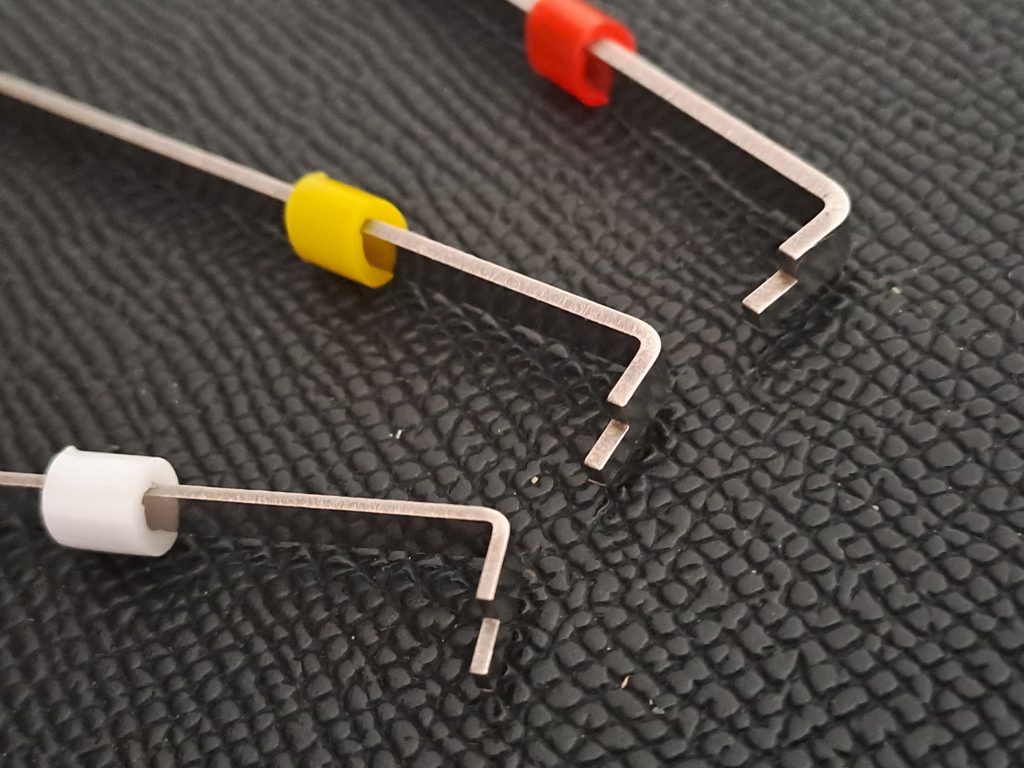
What Is a Tension Tool (Tension Wrench) and How Do You Use One?
Back to Guides & Blogs
Short answer: A tension tool (also called a tension wrench) is a small, flat or angled tool inserted into the keyway to apply light rotational pressure on the lock’s plug while you pick the pins. It doesn’t touch the pins at all. Its only job is to hold that light turning pressure so pins stay set once you lift them into place. Without tension, single pin picking and raking simply don’t work.
What Does a Tension Tool Actually Do?
A pin tumbler lock opens when every pin is pushed to exactly the shear line, the gap between the plug (the part that turns) and the housing around it. Left alone, spring pressure pushes pins back down. Applying light tension to the plug means that as each pin reaches the shear line, it catches slightly on the edge of the plug and stays set, instead of springing back.
Too much tension and the pins bind too hard to move or feel. Too little and set pins fall back down before you finish the rest. Tension is often described as the hardest skill in lock picking to learn, more so than pick handling itself, because it’s almost entirely feel, not sight.
Types of Tension Tools
Bottom-of-Keyway (BOK) Tools
Inserted at the bottom of the keyway, on the opposite side of the plug from the pins. BOK is the more common default overall, and it’s generally the better choice for raking specifically, since it sits clear of the top of the keyway where a rake needs to move freely. The trade-off is that it takes up more physical space in the keyway, which can matter on tight or heavily warded profiles.
Top-of-Keyway (TOK) Tools
Inserted at the top of the keyway, in front of the pins. TOK leaves the most working room in the keyway since it doesn’t sit in the path a pick would normally travel, which some pickers prefer for hooks and single pin picking on tighter keyways. The trade-off is that a TOK tool can get knocked or bumped out during vigorous raking, since it sits closer to where the raking motion happens.
Rigid vs Flexible
Rigid tension tools give more direct, precise feedback and are generally preferred for single pin picking. Flexible or spring-style tension tools (sometimes built into a “feral” style set) can make it easier to hold consistent light pressure without overcorrecting, which some beginners find more forgiving while they’re learning the feel.
None of this is a hard rule; a lot of it comes down to individual preference and the specific keyway you’re working with. Most experienced pickers end up comfortable with both BOK and TOK and choose whichever suits the lock in front of them.
How to Use a Tension Tool: The Basics
- Insert the tension tool into the keyway (bottom or top, depending on your tool and the lock), leaving room for your pick.
- Apply very light rotational pressure in the direction the lock would normally turn to open.
- Keep that pressure steady while you work each pin with your hook or rake.
- As pins set, you’ll feel the plug rotate slightly with each one. That’s your feedback that you’re on the right track.
- If everything binds and nothing moves, you’re using too much tension. If pins keep falling back down, you’re using too little.
This is a genuinely hard skill to describe in words. It’s worth spending real time on a training/cutaway lock specifically to build the feel, rather than jumping straight to picking a real door lock.
Browse the Bare Bones ‘Feral’ Tension Set, 3 sizes →
Common Beginner Mistakes
- Too much tension: the plug feels locked solid and no pins seem to move at all
- Inconsistent tension: easing off between pins lets already-set pins fall back down, undoing progress
- Wrong tool for the keyway: a BOK tool that’s too wide can interfere with pick movement in narrow keyways; switching to a TOK tool or thinner tension tool often solves this
Frequently Asked Questions
What is the difference between BOK and TOK tension tools?
BOK (bottom of keyway) tools sit on the opposite side of the plug from the pins and are generally preferred for raking, since they stay clear of the raking motion. TOK (top of keyway) tools sit in front of the pins, leaving more open working space, which some pickers prefer for hooks on tighter keyways, though they can get knocked loose during vigorous raking.
How much tension should I apply when picking a lock?
As light as possible while still holding set pins in place. There’s no fixed amount, since it varies by lock. Most beginners start with too much tension; if the plug feels completely locked and unresponsive, ease off.
Can I pick a lock without a tension tool?
No, not with standard single pin picking or raking techniques. Tension is what holds pins in place once they’re set. Without it, pins simply spring back down and the lock won’t open.
Do I need different tension tools for different locks?
Often, yes. Keyway width and shape vary between lock brands and types, so having a few different tension tool widths and styles (like a multi-size set) covers more locks than a single tool.
Is a rigid or flexible tension tool better for beginners?
Both work, and it comes down to preference. Rigid tools give more direct feedback, which some beginners find clearer, while flexible or spring-style tools can be more forgiving of small variations in applied pressure while learning the feel.